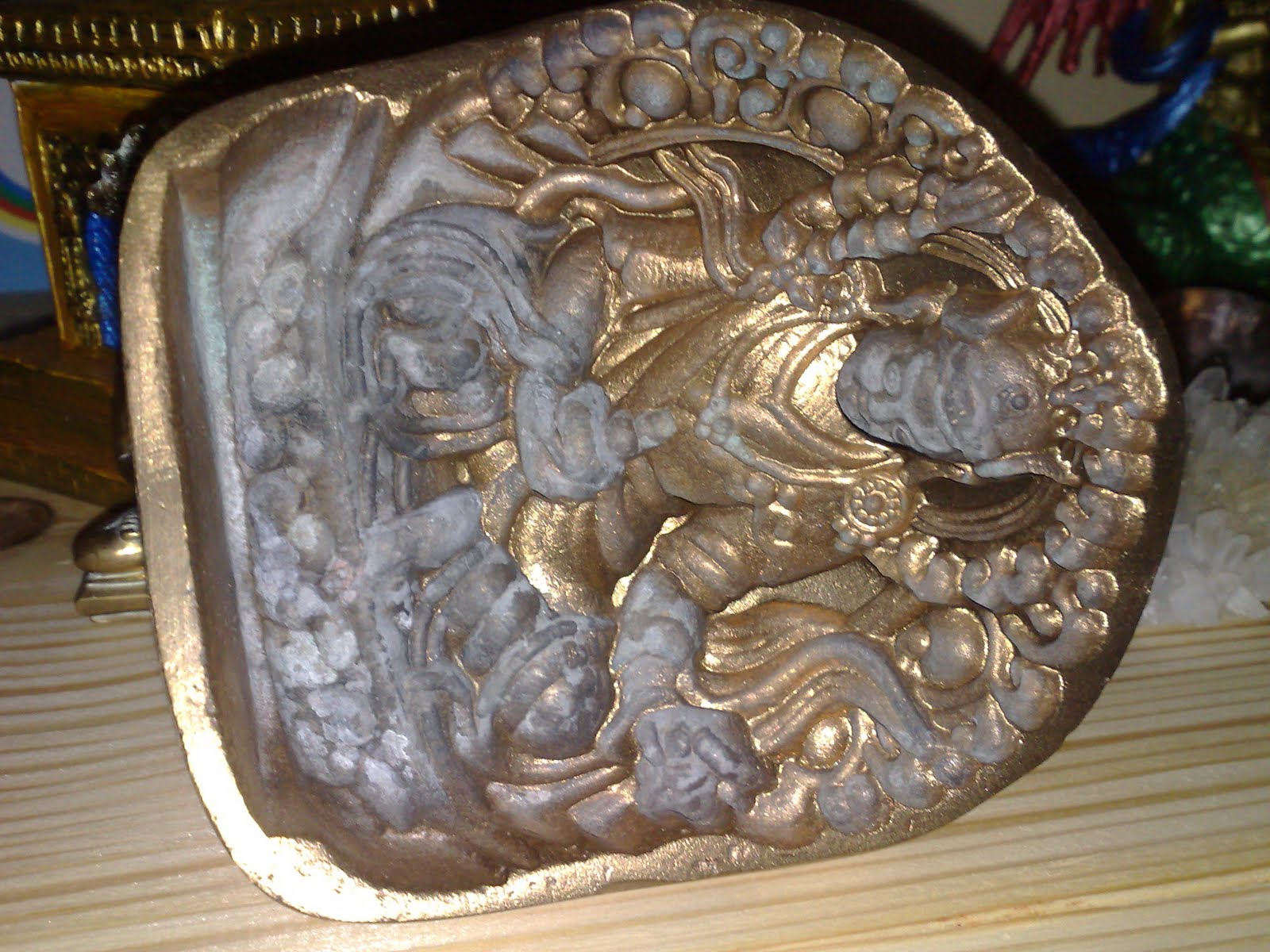
As stated in
Mahaparinirvanna sutra (Pali version): "And
why, Ananda, is a Tathagata, an Arahat, a Fully Enlightened One worthy of a
stupa? Because, Ananda, at the thought: 'This is the stupa of that Blessed One,
Arahant, Fully Enlightened One!' the hearts of many people will be calmed and
made happy; and so calmed and with their minds established in faith therein, at
the breaking up of the body, after death, they will be reborn in a realm of
heavenly happiness. And so also at the thought: 'This is the stupa of that
Pratyekabuddha!' or 'This is the stupa of a disciple of that Tathagata, Arahat,
Fully Enlightened One!' or 'This is the stupa of that righteous monarch who
ruled according to Dharma!' — the hearts of many people are calmed and made
happy; and so calmed and with their minds established in faith therein, at the
breaking up of the body, after death, they will be reborn in a realm of
heavenly happiness. And it is because of this, Ananda, that these four persons
are worthy of a stupa."
A stupa promotes peace and harmony by purifying and
subduing negative forces. In the Buddhist tradition, it is believed that the
construction of stupas, with the sacred vases and other precious materials and
relics placed within them, has the power to restore the earth’s energies and to
help balance the elements. In this way, the construction of stupas helps to
prevent natural disasters, wars, famine, and diseases and they help to balance
the natural forces that promote health, prosperity and well being.It is said
that developing a positive attitude and praying for the peace and happiness of
all sentient beings in the presence of such a sacred object can help to extend
one's life and to pacify sickness.
Visiting and venerating stupas, e.g. by
circumambulating them in a clockwise direction, also ripens one's potential to
attain enlightenment. They create a peaceful environment and inspire well-being
and joy for the whole region in which they are built.
Stupa in
Wangdenling will have the following content:
A.
Sacred
objects, relics and substances:
1.
A vase with relics and blessed substances
given by Chogyal Namkhai Norbu
2.
Shariputra
ringsel. Given by Ven. Dhammadipa. Original tiny ringsel is from Burma
3.
A
hair of Guru Padmasabhava. Given by Karma Lhundrup Rinpoche. He was offered it
by pilgrims from Tibet, who withdrew it from an unkown stupa in Tibet,
destroyed by Chinese.
4.
Relics
of Body-Voice-Mind – relics given by Office of H.H.Dalai Lama, Namgyal temple,
Dharamsala, McLeod Ganj, India
5.
Buddhas
robe. A robe given by Bhikhu Chalinda, Chief monk of Mahabodhi Temple in
Bodhgaya, India, Mahabodhi Society of
India. A robe blessed by being wraped around and worn by the most holy Buddhas statue
inside Mahabodhi temple in Bodhgaya.
6.
Leaves
from the holy Bodhi Tree and chanting text from the above mentioned temple.
7.
A piece
of Mahasiddhas Thagtong Gyalpos cloth (14th century). Given by Karma Lhundrup
Rinpoche. So are all following relics:
8.
Clay
pills from Thangtong Gyalpos flesh.
9.
Mahasiddhas
Thangtong Gyalpo (14th ce) hair and piece of bone.
10. 10th Panchen Lamas Tenpe Wangchuks
cloth piece from Tibet
11. Late H.H. Mindrolling Trichen
Rinpoches hair
12. Om mani padme hum 1 billion Pills from
H.H. 14th Dalai Lama
13. 5 pills containing thousands of relics
of Buddhas and Tibetan masters of 4 schools of Tibetan buddhism.
14. H.H.Sakya Trizins hair (head of the
Sakya School of Tibetan buddhism)
15. H.H.Taklung Tsetruls hair (head of the
Nyingma School of Tibetan buddhism)
16. H.H.Trulshik Rinpoches hair (previous
head of the Nyingma School of Tibetan buddhism)
17. Tulku Urgyen Rinpoches piece of bone
18. Shugseb Jetsunma Rinpoches hair (great
19.century woman master)
19. Kalachakra sand by H.H.Dalai Lamas
from Graz 2002 and Amaravati 2006
20. Relics, stones, and piece of land from
holy places: Bodhgaya and Nairanjana river, Samye Chinphu, many sacred places
in Tibet.
21. Tibetan association Slovakia / is giving following relics
Jowo Buddha mani rilbu (Jokhang Temple,
Lhasa)
Dorje Chang tsa-tsa, Potala Palace
A piece of Potala Palace rock, Lhasa, Tibet
Protective wheat from Nechung
A piece of cloth from Atisha’s
Tara, Drolma Lakhang, Tibet
A photo of Atisha’s Tara, Drolma
Lakhang, Tibet
Tara tsa-tsa, Lhasa (monastery unknown)
Tsa-tsa from Mindroling Monastery,
Nyingma, Tibet
Tsa-tsa from Tama Village (near
Lhasa), Kagyu Gompa near Songtsen Gampo’s birthplace
Sand from Manasarovar, Tibet
Stone from Drolmala Pass, Kailash
White relic from Ngari Hot Springs near
Kailash
Yamataka tsa-tsa, southern Tibet
Stone from Vulture Peak, India
Prajnaparamita text, India
Stone from Bodhgaya Temple
Early statue of Avalokiteshvara, Gandhara
Art, Afghanistan or India, 3rd to 6th century
Buddha image, Pakistan, 5cm, 3rd century
Buddha image, Bactria (Bactria was between
Afghanistan and Pakistan), 3cm, 3rd century
Boddhisattva seated on Lotus, Nepal, 8-9th
century
B. Texts: 1, Canonical texts:
A.
Complete Pali buddhist Canon, Tipitaka in 57 volumes
B.
Complete Chinese Canon: Mahayna Tripitaka in 87
volumes
C.
Tibetan Canon:
1.
Kangjur and Tengjur: Kangjur: Translation of the
Word of the Buddha; 98 Volumes.
- Vinaya: 13 Volumes.
- Prajnaparamita: 21 Volumes.
- Avatamsaka: 6 Volumes.
- Ratnakuta: 6 Volumes.
- Sutra: 30 Volumes. 270 texts, 75% of which are
Mahayana, 25% Hinayana
- Tantra: 22 Volumes. Contains more than 300 texts.
(b) Tengjur:
Translations of the Teachings 224 Volumes
A. Sutras ("Hymns of Praise"): 1 Volume; 64
texts.
B. Commentaries on the Tantras: 86 Volumes; 3055 texts.
C. Commentaries on Sutras; 137 Volumes; 567 texts.
B. Commentaries on the Tantras: 86 Volumes; 3055 texts.
C. Commentaries on Sutras; 137 Volumes; 567 texts.
- Prajnaparamita Commentaries, 16 Volumes.
- Madhyamika Treatises, 29 Volumes.
- Yogacara Treatises, 29 Volumes.
- Abhidharma, 8 Volumes.
- Miscellaneous Texts, 4 Volumes.
- Vinaya Commentaries, 16 Volumes.
- Tales and Dramas, 4 Volumes.
- Technical Treatises, 43 Volumes.
D.
Nyingma
kama. Oral transmission of the Nyingma Tradition in 120 volumes
E.
Nyingma
gyübum. One hundred thousand tantras of the Nyingma Tradition in 46 volumes
F.
Nyingthig
yazhi. Four branches of Heart essence dzogchen upadesha teachings in 13
volumes.
G.
Longchen
Dzödün. Longchenpas seven treasuries.
H.
Dam ngak dzö. Jamgon Kongtrul Rinpoches
Treasury of pith instructions
2.
Treasure teachings
A.) Chögyal
Namkhai Norbu: Longchen ösal khandrö nyingthig. Collection of Rinpoches Longsal
teachings will be donated by Migmar.
B.) Rinchen
terdzö. Collection of Tibets collected terma teachings by Jamgön Kongtrul
Rinpoche and Jamyang Khyentse Wangpo, in 111 volumes.
C.) Gyü zhi.
The four medical tantras revealed as terma by Dragpa Ngöshe and hidden by
Yuthogpa, in 4 volumes.
3.
Dzogchen Community practice texts.
Thun books, guardian practices, explanation and practice booklets.
4. Representations
a, statue of
Buddha Shakyamuni
b, statue of
Guru Padmasambhava
c,
tsa-tsa of Guru Padmasambhava, tsa-tsa of stupa
According
to indications of Chogyal Namkhai Norbu, the work will start on 1st July 2013.
Preparations such us cutting tree of life (sogzhin) we did last year and this
year we have started to coordinate project, collect necessary substances,
relics, texts, making tsa tsas. If there will be best auspicious circumstances,
we will manage to build the stupa early autumn of this Year. If not the late
autumn or in any case next year. We are going to collaborate with other
buddhist groups in preparatory weekend workshops such as preparation of several
hundreds of tsa tsas. For consecration we have invited Chogyal Namkhai Norbu.
In case he will not be able to come, then it is possible H.H. Taklung Tsetrul
Rinpoche, head of the Nyingma school will come and consecrate both gonpa and
stupa in Wangdenling in autumn this year. Regarding the process of
constructions we communicate mainly with Rinpoche, then Giovanni Boni, Migmar,
Artem and Natasha from Izhevsk, Russia and ME East.
stupa main
supervisor: Migmar Tsering, Merigar,
Italy
stupa main
sponsor: Marek Riesz, Bratislava, Slovakia
project
coordinators: Marek Guga and Lukas Chmelik, Slovakia
architects
project: Giovanni Boni, Italy and Merek Guga, Slovakia
Slovak
architect in charge: Marek Guga, Slovakia
Donors of relics:
Chogyal Namkhai Norbu Rinpoche, Merigar, Italy. Ven.Dhammadipa (Thomas Peter
Gutmann), Czech Rep., Ngagpa Karma Lhundrup Rinpoche, Dharamsala, India, Tibetan
association Slovakia / Lubomir Ondrus, Slovakia, Bratislava, etc.
For more info
please have a look:
www.wangdenling.sk